
Dead Buzzard

I’m lucky to live in a valley lined with Celtic rainforest. These are rare, very humid, mild-climate woodlands on the UK’s western coast, characterized by ancient broadleaf covered in mosses, lichens, and ferns.
Walking the dog in the green valley twice a day, I have the increasingly unique pleasure of being able to witness seasons change in real time. We came here from a sprawling concrete estate in Tottenham where the main seasonal indicators were day length and Christmas decorations.
In Cwmcych, not only do I get to see the ash trees losing their leaves first in autumn, then the birch, then the oak, but also which oaks go before others depending on their place in the valley.
Right now, I’m tracking the briallu (primroses) and trying to remember the order that the cennin pedr (daffodils) flower. There are two song thrushes singing continually, each with a preferred tree, and by the river, the heron stands sentinel while a dipper patrols like a scrambled fighter. As with everything, the more interest I take in it all, the more it rewards. And anything out of place - fallen branch, new stream, dead bird - is instantly noticeable.
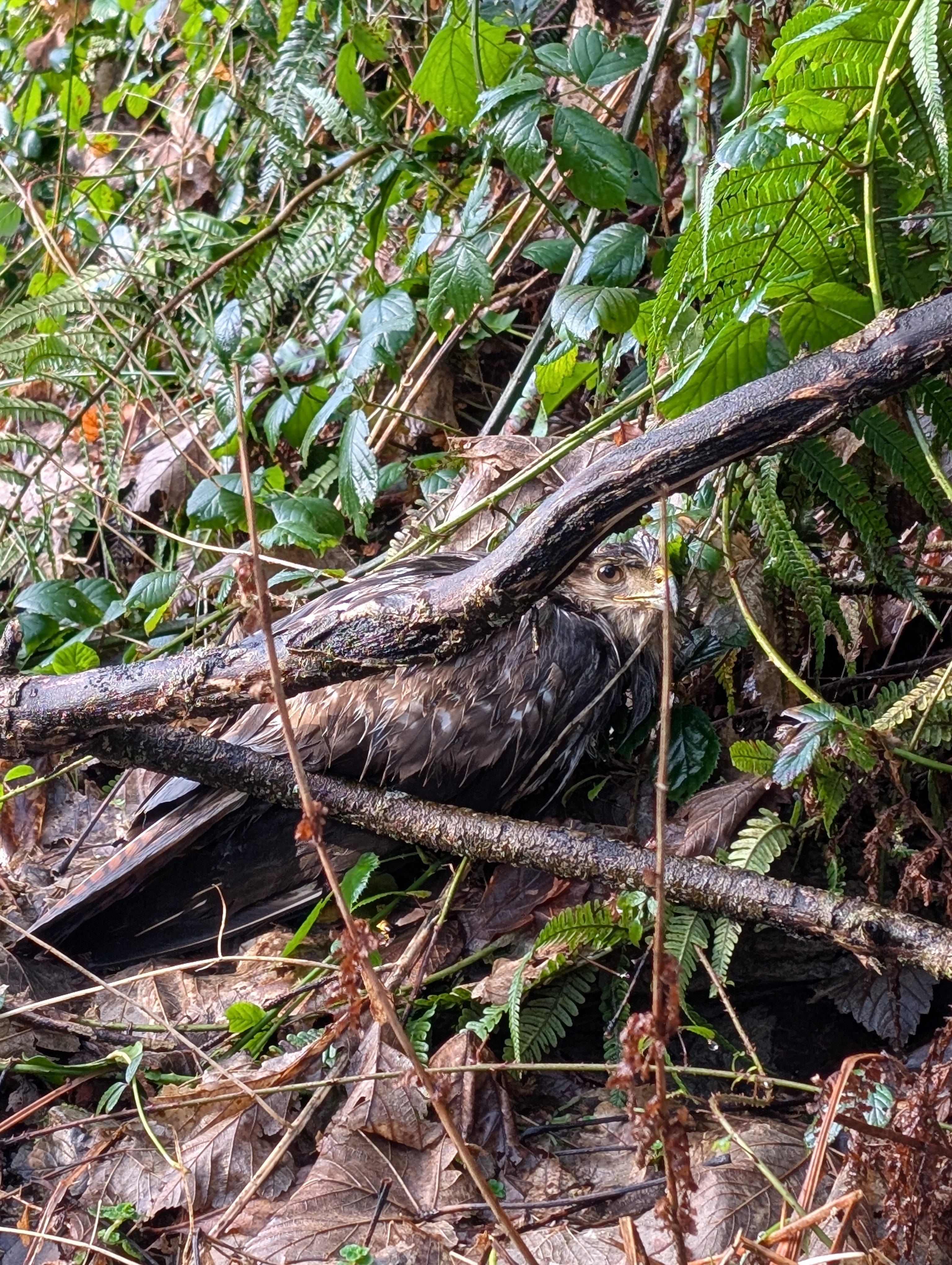
Up in the woods last week, we encountered a motionless feathery mass beneath a well dug by some industrious Victorian Cymro. The bird was so still my otherwise frenetic companion wasn’t interested. I gasped though. It was a buzzard.
I could sense it straining to get away but the only feedback its body was giving was a single eye blink. Saying “aww mate” didn’t quite capture the indignity of a creature, that after millions of ancestral evolutions had spent its life soaring, now defenceless in the mud.
Conflictingly, I was very aware that it was a privilege to be so close to the ferocious eyes, flesh ripping beak and razor talons, of something this wild. After dithering, I determined to go home and get a cardboard box and a towel and see what I could do.
Approaching it thirty minutes later I could tell it was dead from twenty metres away. I spent my twenties working in a hospital as an auxiliary nurse and encountered a lot of death there. This was the same. Only as life exits a body, do you sense what life really is.
When we were laying people out the window was always opened to let the ‘soul escape.’ On a windswept hillside, this bird’s soul was already wherever it needed to be. I carefully lifted it into my box and placed it on the incongruous Leeds Rhinos towel I’d planned to warm it with.
Walking back, I reflected that I must have stopped whatever I was doing to observe this local raptor soaring above us on multiple occasions. And that on each of those occasions as it was continuing to do now, it filled me with awe. What a privilege.
I’m only experiencing the complexity of an ecosystem for the first time in my forties because I’m lucky. For most, we’re in a state of environmental amnesia, as the baseline for what constitutes a heathy one degrades with each generation.
I doubt the buzzard comprehended the passing of time as we do. But in many ways, its chief instincts - to survive and to perpetuate – give it a much firmer grasp of the precarious nature of things.
And ultimately, it is not the one in trouble. On our greenhouse gas equivocating trajectory, it is the carrion eaters who will inherit the earth.
Thank you for this poignant, diverting vignette, which was like a window opening in my dreary day.
It’s paused at the moment because of avian flu, but in the UK the Predatory Bird Monitoring Scheme is a fantastic long running study into the causes of death in raptors. When it’s open again, they accept carcasses for post mortem and they feed back to you the report on “your” bird. So if you find one again do consider submitting it - at least more knowledge can come from death. It’s really important for tracking the impact of things such as pesticides.